Version 2.0

True end-to-end Design

Tokenomics Design for
Web3 Projects

Tokenomics
Design for
web3 projects

Tokenomics Design for web3 projects

Cursor
Cursor
Cursor

Your all-in-one solution for your tokenomics, from

economic design to fundraising setup, financial modeling, incentives, game theory, simulations and documentation.

Modern SaaS dashboard showing total sales, revenue, customer data, and performance analytics with interactive charts and graphs.
Cursor

Three Core Principles

Three Core Principles

Data-Driven
Approach to Tokenomics

A key strength of our methodology is its empirical foundation: we maintain a dataset of 2,000+ tokenomics models.

Data-Driven
Approach to Tokenomics

A key strength of our methodology is its empirical foundation: we maintain a dataset of 2,000+ tokenomics models.

Data-Driven
Approach to Tokenomics

A key strength of our methodology is its empirical foundation: we maintain a dataset of 2,000+ tokenomics models.

First-Principle
Tokenomics Framework

We are know for our first-principles tokenomics framework that covers eight detailed verticals.

First-Principle
Tokenomics Framework

We are know for our first-principles tokenomics framework that covers eight detailed verticals.

Data-Driven
Approach to Tokenomics

We are know for our first-principles tokenomics framework that covers eight detailed verticals.

Fundamentals
Expertise in Value Accrual

We don’t work or design projects where the token is disconected from revenue and driven by speculation

Fundamentals
Expertise in Value Accrual

We don’t work or design projects where the token is disconected from revenue and driven by speculation

Data-Driven
Approach to Tokenomics

We don’t work or design projects where the token is disconected from revenue and driven by speculation

How does it work?

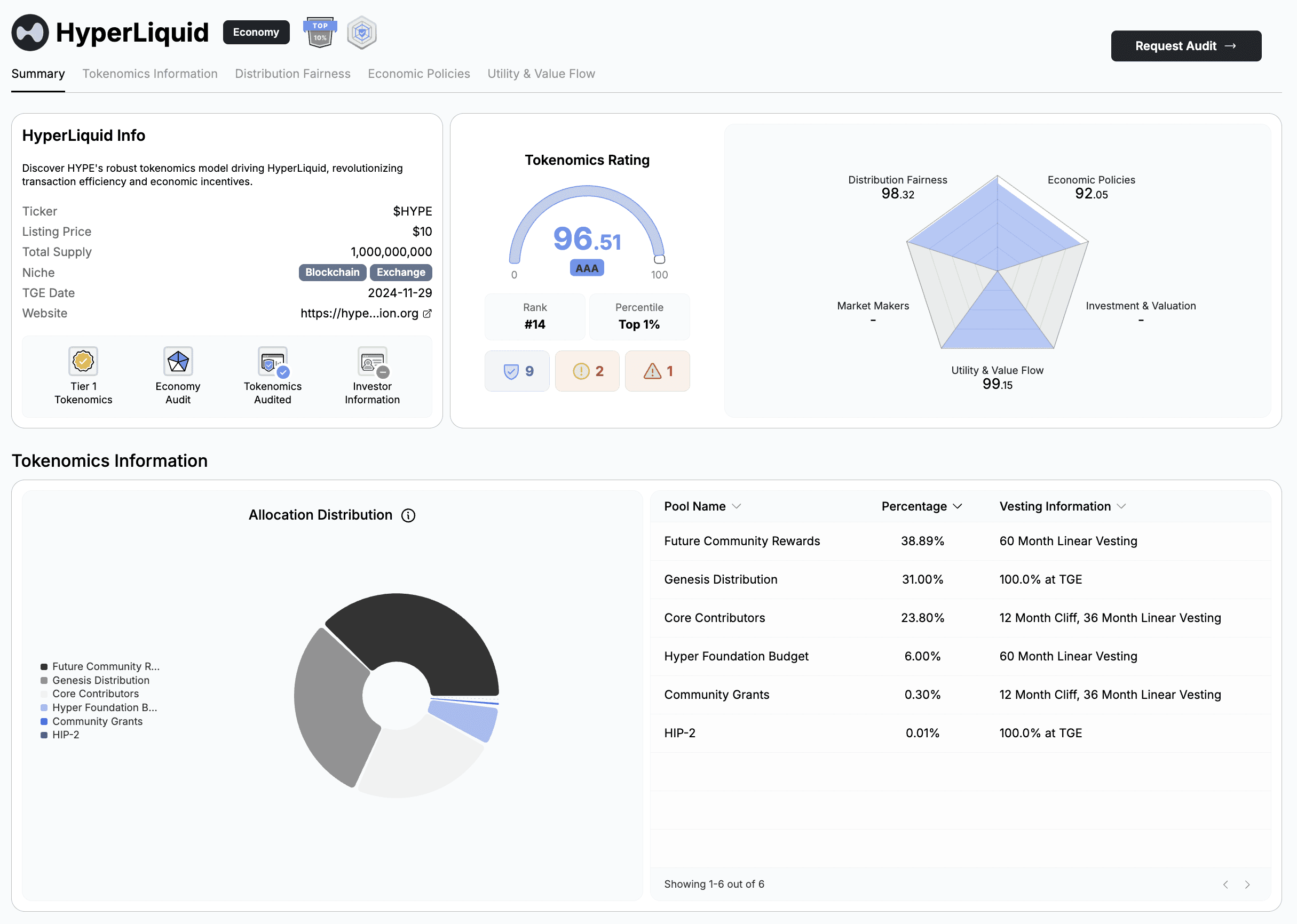
This document aims to show clarity on our systematic process to auditing tokenomics frameworks and our structured audit methodology. There is no such thing as a perfect tokenomics model, only balanced models and to determine whether a tokenomics model is balanced, it is essential to analyze all of these verticals together.

This is why we use a pentagon methodology, ensuring that no single element is evaluated in isolation.
(Five verticals and 23 components)

Choose the plan
that fits your team best.

Choose the plan
that fits your team best.

Limited

Everything you need to raise funds

End-to-end

We architect your entire tokenomics

Designed for

Token Sales / Fundraising

TGE / Launch

Timeline

45 days

3 - 4 months

Economic Design

Valuation, Investors terms and conditions

Token Utility and Value Capture Design

Value Accrual Mechanisms

Financial Modeling

Incentive System

Game Theory and iterations

Simulation (cadCAD, Monte Carlo, etc)

Liquidity Terms and Conditions

Documentation

Investors & Community

For Investors

Limited
End-to-end

Designed for

Fundraising

Launch

Timeline

45 days

3 - 4 months

Economic Design

Valuation and Investors terms

Token Utility and Value Capture

Value Accrual Mechanisms

Financial Modeling

Incentive System

Game Theory and iterations

Simulation

Liquidity Conditions

Documentation

Included

For Investors

Limited

Everything you need to raise funds

End-to-end

We architect your entire tokenomics

Designed for

Token Sales / Fundraising

TGE / Launch

Timeline

45 days

3 - 4 months

Economic Design

Valuation, Investors terms and conditions

Token Utility and Value Capture Design

Value Accrual Mechanisms

Financial Modeling

Incentive System

Game Theory and iterations

Simulation (cadCAD, Monte Carlo, etc)

Liquidity Terms and Conditions

Documentation

Investors & Community

For Investors

Cursor
Cursor

Simulation toolkit

Interface

Simulations

We use four complementary approaches: deterministic (fixed-input baselines), stochastic (via randomness), agent-based (participant behavior and incentives), and Monte Carlo (thousands of runs to map outcome distributions).

We use four complementary approaches: deterministic (fixed-input baselines), stochastic (via randomness), agent-based (participant behavior and incentives), and Monte Carlo (thousands of runs to map outcome distributions).

We use four complementary approaches: deterministic (fixed-input baselines), stochastic (via randomness), agent-based (participant behavior and incentives), and Monte Carlo (thousands of runs to map outcome distributions).

Deterministic (Machinations)

Deterministic (Machinations)

Deterministic (Machinations)

Stochastic (cadCAD)

Stochastic (cadCAD)

Stochastic (cadCAD)

Agent-based Simulations

Agent-based Simulations

Agent-based Simulations

Monte Carlo Engine (p10-p90)

Monte Carlo Engine (p10-p90)

Monte Carlo Engine (p10-p90)

FAQs

Got questions?
We’ve got answers.

Got more questions?We’ve got answers.

Here’s everything you need to know before getting started.

Still have questions?

Contact us on telegram

Still have questions?

Contact us on telegram

1. What is a tokenomics audit for institutional investors?

A tokenomics audit is a data-driven due diligence process that evaluates a project’s token economy before investment. Tokenomics.com analyzes supply schedules, vesting structures, valuation models, and incentive alignment to identify risks that could lead to inflation, dilution, or misaligned incentives. For funds and VCs, this means preventing costly investments in projects with flawed tokenomics structures.

2. Why do VCs and funds need tokenomics audits before investing?

Broken tokenomics have caused billions in investor losses. Auditing tokenomics before investing identify hidden risks like: unsustainable emissions, poor float control, and unrealistic valuation. Assumptions that traditional technical or legal due diligence misses. Tokenomics.com helps investors protect capital and optimize portfolio performance through economic validation.

3. What does Tokenomics.com analyze in a tokenomics audit?

To determine whether a tokenomics model is balanced, it is essential to analyze all of these verticals together. This is why we use a pentagon audit approach with five core areas: distribution fairness, investement terms and conditions, value capture and accrual and liquidity conditions ensuring that no single element is evaluated in isolation.

4. How does Tokenomics.com support investors post-investment?

Once a fund invests, we act as an independent third-party mediator if the project proposes changes to its tokenomics. This prevents conflicts of interest between investors and founders and ensures that all revisions maintain fair economic balance.

5. How accurate is the data behind Tokenomics.com audits?

We maintain the largest institutional database of tokenomics data with over 2,000 project records and more than 750 audits completed. Each report cross-references the project’s parameters with historical price action and benchmarked performance from comparable launches.

6. How can institutional investors integrate with Tokenomics.com?

Investors can book a demo, request API access, or connect their Liquid Fund intelligence directly through our platform. Institutional integrations include analytics dashboards, audit pipelines, and LP transparency modules.

1. What is a tokenomics audit for institutional investors?

A tokenomics audit is a data-driven due diligence process that evaluates a project’s token economy before investment. Tokenomics.com analyzes supply schedules, vesting structures, valuation models, and incentive alignment to identify risks that could lead to inflation, dilution, or misaligned incentives. For funds and VCs, this means preventing costly investments in projects with flawed tokenomics structures.

2. Why do VCs and funds need tokenomics audits before investing?

Broken tokenomics have caused billions in investor losses. Auditing tokenomics before investing identify hidden risks like: unsustainable emissions, poor float control, and unrealistic valuation. Assumptions that traditional technical or legal due diligence misses. Tokenomics.com helps investors protect capital and optimize portfolio performance through economic validation.

3. What does Tokenomics.com analyze in a tokenomics audit?

To determine whether a tokenomics model is balanced, it is essential to analyze all of these verticals together. This is why we use a pentagon audit approach with five core areas: distribution fairness, investement terms and conditions, value capture and accrual and liquidity conditions ensuring that no single element is evaluated in isolation.

4. How does Tokenomics.com support investors post-investment?

Once a fund invests, we act as an independent third-party mediator if the project proposes changes to its tokenomics. This prevents conflicts of interest between investors and founders and ensures that all revisions maintain fair economic balance.

5. How accurate is the data behind Tokenomics.com audits?

We maintain the largest institutional database of tokenomics data with over 2,000 project records and more than 750 audits completed. Each report cross-references the project’s parameters with historical price action and benchmarked performance from comparable launches.

6. How can institutional investors integrate with Tokenomics.com?

Investors can book a demo, request API access, or connect their Liquid Fund intelligence directly through our platform. Institutional integrations include analytics dashboards, audit pipelines, and LP transparency modules.

1. What is a tokenomics audit for institutional investors?

A tokenomics audit is a data-driven due diligence process that evaluates a project’s token economy before investment. Tokenomics.com analyzes supply schedules, vesting structures, valuation models, and incentive alignment to identify risks that could lead to inflation, dilution, or misaligned incentives. For funds and VCs, this means preventing costly investments in projects with flawed tokenomics structures.

2. Why do VCs and funds need tokenomics audits before investing?

Broken tokenomics have caused billions in investor losses. Auditing tokenomics before investing identify hidden risks like: unsustainable emissions, poor float control, and unrealistic valuation. Assumptions that traditional technical or legal due diligence misses. Tokenomics.com helps investors protect capital and optimize portfolio performance through economic validation.

3. What does Tokenomics.com analyze in a tokenomics audit?

To determine whether a tokenomics model is balanced, it is essential to analyze all of these verticals together. This is why we use a pentagon audit approach with five core areas: distribution fairness, investement terms and conditions, value capture and accrual and liquidity conditions ensuring that no single element is evaluated in isolation.

4. How does Tokenomics.com support investors post-investment?

Once a fund invests, we act as an independent third-party mediator if the project proposes changes to its tokenomics. This prevents conflicts of interest between investors and founders and ensures that all revisions maintain fair economic balance.

5. How accurate is the data behind Tokenomics.com audits?

We maintain the largest institutional database of tokenomics data with over 2,000 project records and more than 750 audits completed. Each report cross-references the project’s parameters with historical price action and benchmarked performance from comparable launches.

6. How can institutional investors integrate with Tokenomics.com?

Investors can book a demo, request API access, or connect their Liquid Fund intelligence directly through our platform. Institutional integrations include analytics dashboards, audit pipelines, and LP transparency modules.

Contact us

For more information contact us at:

LinkedIn Logo
Tokenomics.com Logo

Copyright © 2024. All rights reserved.

Contact us

For more information contact us at:

Start chat in Telegram

LinkedIn Logo
Tokenomics.com Logo

Copyright © 2024. All rights reserved.

Contact us

For more information contact us at:

Learn More

LinkedIn Logo
Tokenomics.com Logo

Copyright © 2024. All rights reserved.