Written:
Feb 1, 2026
Learn how Uniswap tokenomics evolved from governance-only to value accrual. Understand the UNI fee switch, token burns, and what it means for holders.
Uniswap tokenomics underwent a seismic shift in December 2025. For over five years, UNI existed purely as a governance token with no direct value accrual. That changed when the UNIfication proposal passed with overwhelming support, activating the long-awaited fee switch and introducing a token burn mechanism. This guide breaks down how UNI tokenomics work, the original design, and what the fee switch means for token holders.
What is UNI Token?
UNI is the native governance token of Uniswap, the largest decentralized exchange (DEX) by historical trading volume. Launched on September 15, 2020, UNI gave the community control over protocol parameters, treasury allocation, and future development decisions.
Key Stats: UNI has a maximum supply of 1 billion tokens, with approximately 634 million (63.4%) currently in circulation. The token trades at a market cap of roughly $2.5 billion with a fully diluted valuation of $3.6 billion.
Unlike many DeFi tokens, UNI was designed without built-in revenue sharing or staking rewards. This made it a "pure governance" token, valuable for voting rights but without direct cash flows from protocol activity.
UNI Token Distribution and Allocation
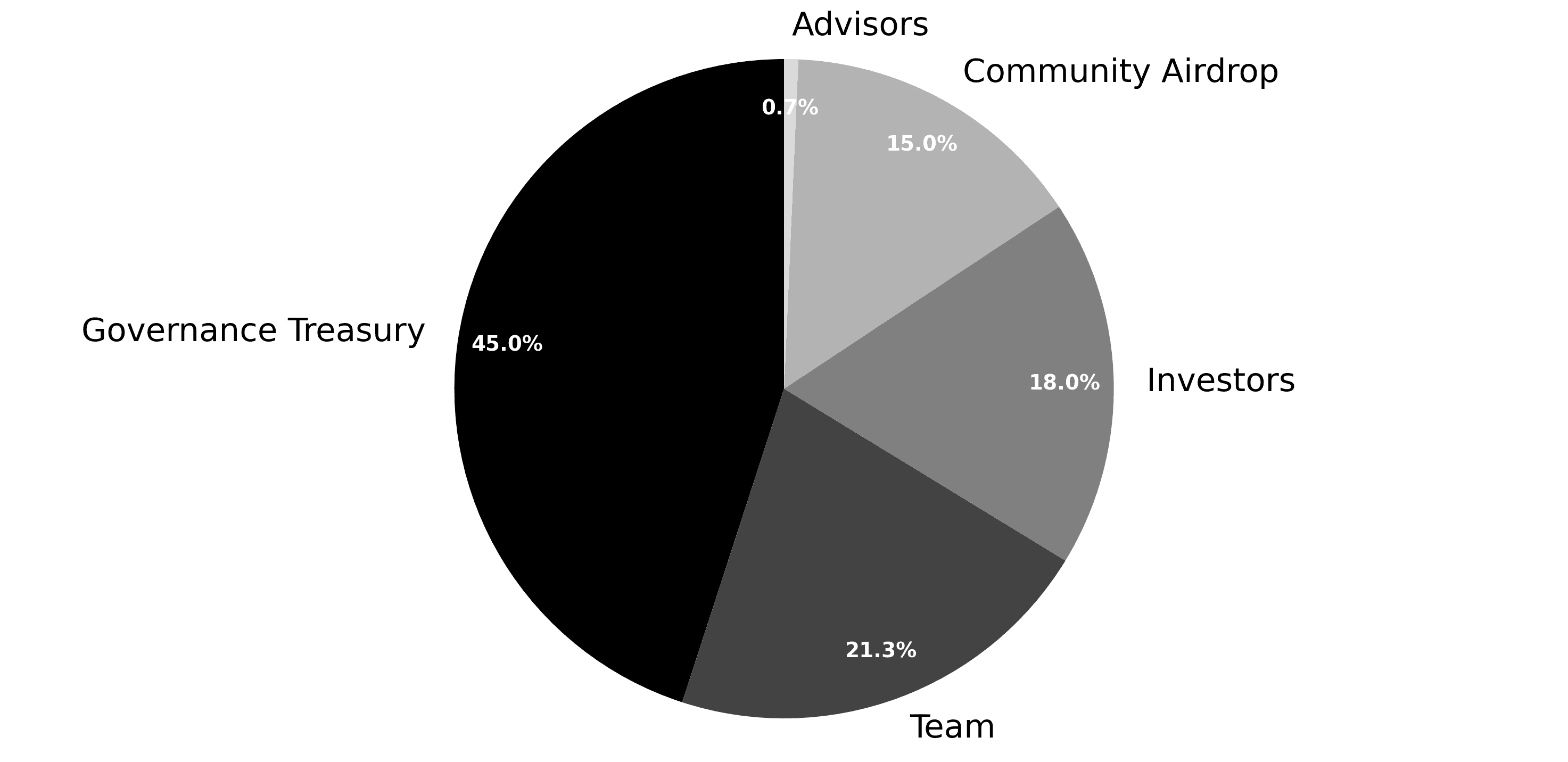
Understanding Uniswap tokenomics starts with the initial distribution. Uniswap's token allocation reflects its commitment to decentralization, with the community receiving the largest share over time.
Initial Allocation Breakdown
Allocation | Percentage | Tokens | Vesting |
Governance Treasury | 45% | 450,000,000 | Released over 4 years |
Team | 21.27% | 212,660,000 | 4-year linear vesting |
Investors | 18.04% | 180,440,000 | 4-year linear vesting |
Community Airdrop | 15% | 150,000,000 | 100% at TGE |
Advisors | 0.69% | 6,900,000 | 4-year linear vesting |
The legendary September 2020 airdrop distributed 150 million UNI to historical users. Anyone who had ever used Uniswap received at least 400 tokens. At launch prices, this gave early users roughly $1,200. At UNI's all-time high, that same airdrop was worth over $17,000.
Distribution Fairness Analysis
According to tokenomics scoring data, Uniswap ranks in the 86th percentile for distribution fairness among DeFi projects. The large governance treasury allocation (45%) and substantial community airdrop contributed to this strong score.
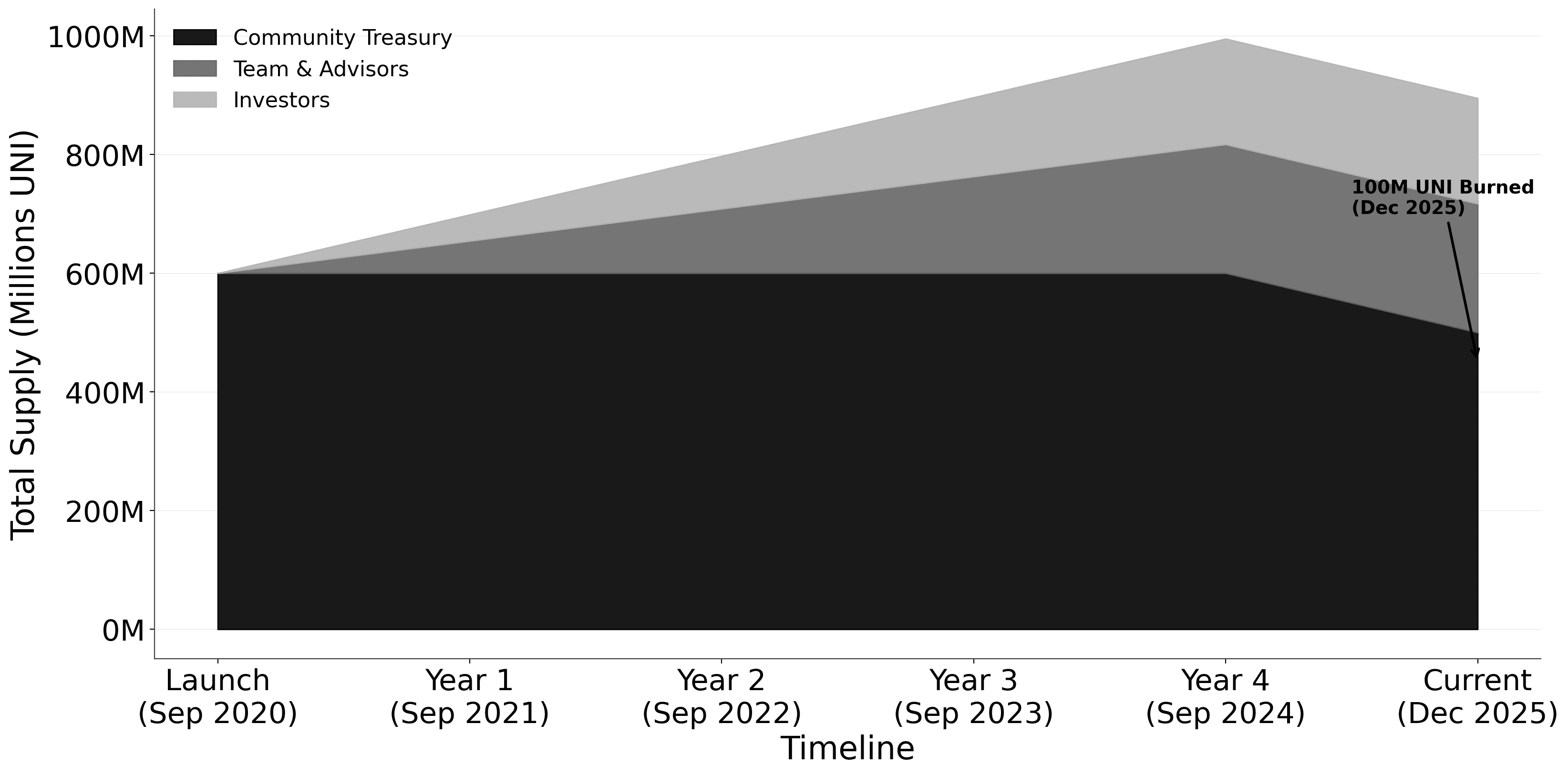
However, combined insider and investor allocations totaling nearly 40% placed some constraints on decentralization during the vesting period. By August 2024, all team and investor tokens had fully vested.
Original Tokenomics
The original Uniswap tokenomics model was lazy. For its first five years, UNI operated under a governance-only model. Token holders could vote on proposals, delegate voting power, and participate in protocol decisions. But there was no mechanism for UNI holders to capture value from Uniswap's massive trading volume.
The Fee Structure Before the Switch
Uniswap charges trading fees that go entirely to liquidity providers (LPs):
Uniswap V2: 0.30% flat fee to LPs
Uniswap V3: Variable fees (0.01%, 0.05%, 0.30%, or 1.00%) to LPs
The protocol itself, and by extension UNI holders, received nothing from these fees. This created an unusual situation: Uniswap generated over $5.38 billion in cumulative trading fees, yet none flowed to the token.
Why Governance-Only Made Sense Initially
The governance-only approach served several purposes:
Regulatory caution: Avoiding revenue distribution reduced securities law concerns
LP attraction: Keeping all fees with LPs maximized liquidity depth
Decentralization signal: Demonstrated commitment to community over profit extraction
But as competitors like Curve and Sushiswap implemented token holder rewards, pressure mounted for Uniswap to activate its dormant fee switch.
The Fee Switch
In late December 2025, Uniswap governance approved the "UNIfication" proposal with over 125 million votes in favor and only 742 dissenting. This activated the protocol fee switch and fundamentally restructured UNI tokenomics.
How the Fee Switch Works
The fee switch redirects a portion of trading fees from liquidity providers to the protocol. Rather than accumulating as protocol revenue, these fees flow into a token burn mechanism.
New Fee Structure:
Version | LP Fee (Before) | LP Fee (After) | Protocol Fee |
Uniswap V2 | 0.30% | 0.25% | 0.05% |
Uniswap V3 (0.05% pools) | 0.05% | ~0.04% | ~0.01% (1/4 of LP fee) |
Uniswap V3 (0.30% pools) | 0.30% | 0.25% | 0.05% (1/6 of LP fee) |
The Burn Mechanism
Two smart contracts manage the fee-to-burn pipeline:
TokenJar: Accumulates protocol fees from trading activity
Firepit: Burns UNI tokens. Withdrawals are only possible when equivalent UNI is destroyed
This creates a direct link between protocol usage and token supply reduction. More trading volume means more fees, which means more UNI burned.
Rollout Phases
The fee switch activation follows a phased approach:
Phase 1 (Current): V2 pools plus high-volume V3 pools on Ethereum mainnet, covering 80-95% of LP fees
Future Phases: Layer 2 deployments, other chains, Uniswap V4, UniswapX, and Protocol Fee Discount Auctions will be activated through separate governance proposals
This measured rollout allows the community to assess impact before expanding to the full protocol.
Protocol Fee Discount Auctions (PFDA)
Beyond direct fee collection, the UNIfication proposal introduces Protocol Fee Discount Auctions, an MEV capture mechanism. These auctions grant temporary swap fee exemptions to the highest bidder, with all winning bids directed to the UNI burn.
Early modeling suggests PFDAs could improve LP returns by $0.06-$0.26 for every $10,000 traded, while simultaneously increasing burn revenue. This mechanism captures value that would otherwise flow to MEV searchers and validators.
Unichain Integration
The UNIfication proposal also integrated Uniswap's Layer 2 chain, Unichain, into the burn mechanism. With approximately $100 billion in annualized DEX volume, Unichain generates roughly $7.5 million in annual sequencer fees. After deducting L1 data costs and Optimism's 15% share, remaining sequencer revenue flows to the burn.
Value Accrual Mechanics Explained
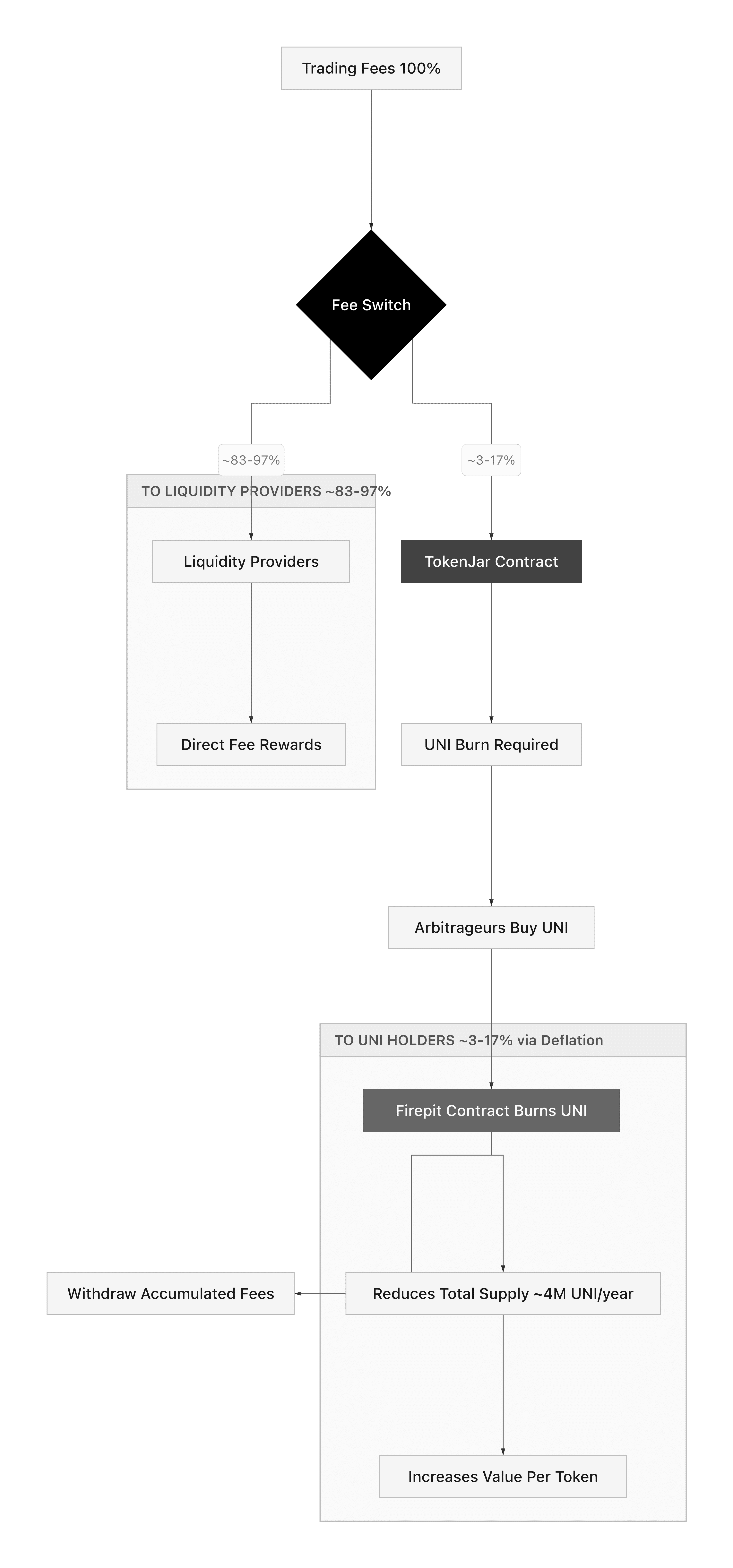
The fee switch fundamentally transforms Uniswap tokenomics, converting UNI from a governance-only token to one with embedded deflation based on protocol activity.
Early Performance Data
Within the first 12 days of activation:
Cumulative protocol fees: ~$800,000
Annualized run rate: ~$26 million
Implied burn rate: ~4 million UNI per year (0.4% of supply)
The 100 Million Token Burn
Beyond ongoing burns from fees, the proposal included a one-time treasury burn of 100 million UNI, worth approximately $590 million at the time. This retroactive burn represented fees that could have accrued had the switch been active since Uniswap's 2018 launch.
Valuation Implications
With $26 million in annualized protocol fees and a $5.4 billion market cap, UNI trades at roughly a 207x revenue multiple. This valuation prices in significant growth expectations. The burn rate would need to increase substantially to materially impact circulating supply.
For context, at current rates:
Annual burn: ~4 million UNI
Circulating supply: 634 million UNI
Years to burn 10% of supply: ~16 years
The market is betting on trading volume growth and fee expansion across new chains and versions.
Economic Impact: Before vs After
Comparison Table
Metric | Before Fee Switch | After Fee Switch |
Value to UNI holders | Governance rights only | Governance + deflation |
Protocol revenue | $0 | ~$26M annualized |
LP fee (V2) | 0.30% | 0.25% |
Token supply trend | Fixed at 1B max | Deflationary |
Revenue multiple | N/A (no revenue) | ~207x |
Impact on Liquidity Providers
The fee switch reduces LP earnings by approximately 16-20% depending on the pool. For a V2 pool, LPs now receive 0.25% instead of 0.30%, a 16.7% reduction.
This creates a potential trade-off: if reduced LP incentives lead to lower liquidity, trading execution could suffer. However, Uniswap's dominant market position and network effects may absorb this impact without significant liquidity flight.
Competitive Positioning
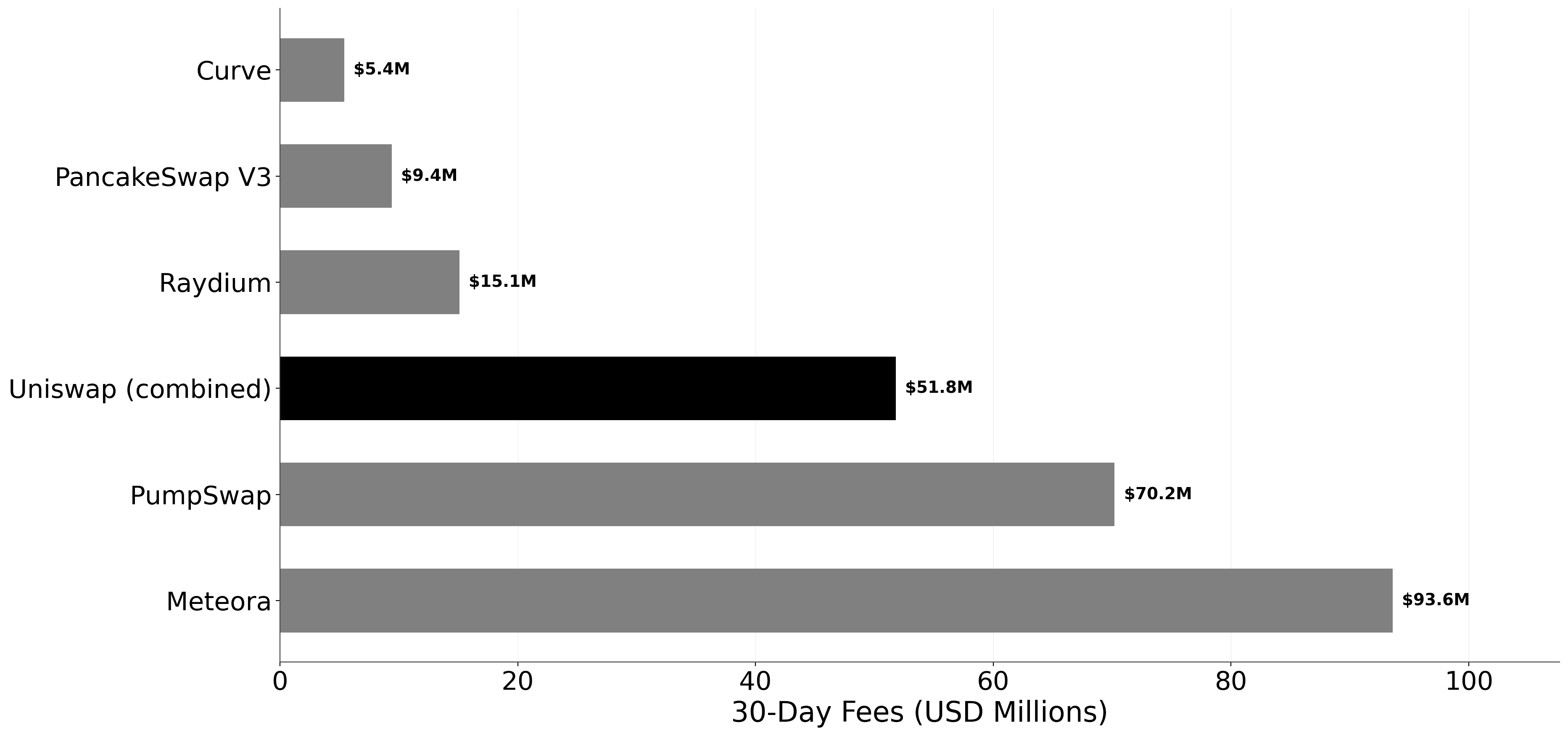
Uniswap's fee switch arrives as DEX competition intensifies. Current 30-day fee generation across major DEXes:
Protocol | 30-Day Fees | All-Time Fees |
Uniswap (all versions) | $51.8M | $5.38B |
Meteora (Solana) | $93.6M | $1.17B |
PumpSwap (Solana) | $70.2M | $444M |
Raydium | $15.1M | $1.37B |
PancakeSwap V3 | $9.4M | $607M |
Curve | $5.4M | $363M |
Despite newer Solana-based DEXes generating higher short-term fees, Uniswap's $5.38 billion in cumulative fees demonstrates unmatched historical dominance.
Key Takeaways
Uniswap tokenomics changed fundamentally with the December 2025 fee switch activation
UNI launched in September 2020 as a governance-only token with 1 billion maximum supply
The December 2025 fee switch activation transformed UNI into a deflationary asset
Protocol fees now fund token burns at an estimated rate of ~4 million UNI per year
A 100 million UNI treasury burn was executed as part of the UNIfication proposal
Uniswap has generated over $5.38 billion in cumulative trading fees across all versions
UNI currently trades at approximately 207x its annualized protocol revenue
Conclusion
Uniswap tokenomics have evolved from a pure governance model to one with direct value accrual through token burns. The fee switch represents one of the most significant tokenomic changes in DeFi history, arriving after years of community debate and regulatory caution.
For UNI holders, the change introduces deflation tied to protocol usage. The more people trade on Uniswap, the more tokens get burned. Whether the current ~0.4% annual burn rate justifies UNI's valuation depends on growth expectations for trading volume across Ethereum, L2s, and Unichain.
The transformation from governance token to value-accruing asset marks a new chapter for Uniswap. Combined with $5.38 billion in historical fees and continued protocol development, UNI tokenomics now align holder incentives with protocol success in ways the original design never intended.
FAQs
Uniswap Tokenomics FAQ
What is UNI token used for?
UNI serves two primary functions: governance and value accrual. Holders can vote on protocol upgrades, treasury allocations, and parameter changes. Following the December 2025 fee switch activation, UNI also benefits from deflationary pressure as protocol fees are used to buy and burn tokens.
Does UNI have value accrual now?
Yes. The new Uniswap tokenomics model directs protocol fees into a burn mechanism that reduces UNI supply. Early data suggests approximately $26 million in annualized fees, translating to roughly 4 million UNI burned per year. This represents about 0.4% annual supply reduction.
What is the Uniswap fee switch?
The fee switch is a governance-controlled mechanism that redirects a portion of trading fees from liquidity providers to the protocol. In Uniswap V2, this means 0.05% of each trade (out of 0.30% total) goes to protocol fees rather than LPs. These fees are then used to burn UNI tokens.
How much UNI was burned in the treasury burn?
The UNIfication proposal included a one-time retroactive burn of 100 million UNI from the governance treasury, worth approximately $590 million. This was intended to reflect fees that would have accrued if the fee switch had been active since launch.
Will the fee switch reduce liquidity on Uniswap?
The fee switch reduces LP earnings by 16-20% depending on the pool type. While this could theoretically push some liquidity providers to competing platforms, Uniswap's dominant market position, deep liquidity, and strong brand may offset these concerns. Early data since activation hasn't shown significant liquidity flight.
About the Author
Founder of Tokenomics.com
With over 750 tokenomics models audited and a dataset of 2,500+ projects, we’ve developed the most structured and data-backed framework for tokenomics analysis in the industry.
Previously managing partner at a web3 venture fund (exit in 2021).
Since then, Andres has personally advised 80+ projects across DeFi, DePIN, RWA, and infrastructure.